The Gem and Jewelry World's Foremost Resource on The Internet.
 
   for   in     
Add Ganoksin Power Search to your website
 
| Site Map | Jewelry Making Articles | Orchid Forums & Archives | Galleries | The BenchExchange | MetalCalc |
| Industry Web Sites Guide | Press Room | Advertising | Contact Us | Link to Us | More...

  Tips from The jeweler's bench
The Gem and Jewelry World's foremost Resource on The Internet. Open to the public, Free of Charge!
We are here to build a strong pool of information for the benefit of Web's jewelers and craftsmen - and those interested in jewelry and gemstones.


Library >  Chasing and repousse
 
Page: 2 
 
[445] Brepohl on chasing and repousse
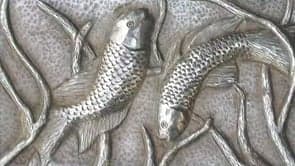
The terms repousse and chasing are often confused and not without good reason since the two techniques are often worked together. One might as well think of ‘slipping and sliding’ to realize how difficult to establish a clear definition particular to each process. In general we might think of repousse as primarily a relief and chasing as more often an intaglio (2-D or linear) technique.... (2001)
Complete Story

Show me more articles from: [The Theory and Practice of Goldsmithing]|[Prof. Dr. Erhard Brepohl]
Releated Categories: [Chasing and repousse]
ISBN: 0961598492


[612] Chasing, Repousse and Pitch Safety Notes
An ancient system of working metals, this procedure uses steel punches to manipulate the metal while it is fixed onto a pitch or tar-like material. There are traditional pine-resin pitches and modern petroleum-based ones. The petroleum-based pitches are considered potential dermatitis-causing materials, as well as some evidence of their being carcinogenic. At this point most jewelers pitches available through the main suppliers are petroleum-based, and thus, in my opinion, suspect. Besides, they do not work nearly as nicely as the pine pitches.... (2005)
Complete Story

Show me more articles from: [The Jewelry Workshop Safety Report]|[Charles Lewton-Brain]
Releated Categories: [Chasing and repousse]|[Workshop Safety]
ISBN: 0969851049


[59] Goldsmiths pitch options
Pitch is used all over the world by goldsmiths and silversmiths to hold metal in place while working it with hammers, punches or chisels. It should be hard enough to fill the requirements of the chasing work done on it. Most chasers will therefore have several hardnesses available, a soft one for deep forming, a medium for regular work and a hard for planishing on. In the old days chasers would even have summer and winter formulations.... (1998)
Complete Story

Show me more articles from: [Brain Press Publications]|[Charles Lewton-Brain]
Releated Categories: [Chasing and repousse]|[Small Tools]


[36] Making a Chasing or forming tool
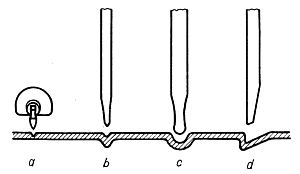
We are assuming you are using W1 water hardening square stock drill rod, W1 tool steel. Many suppliers will sell W1 tool steel. It is often called drill rod (In England 'silver steel'). It should be square for less work in tool making, but round drill rod can be filed or forged to square. You should not use key stock, which some hardware suppliers will try and sell to you: it cannot be hardened as described below.... (2002)
Complete Story

Show me more articles from: [Brain Press Publications]|[Charles Lewton-Brain]
Releated Categories: [Homemade Tools]|[Chasing and repousse]


[290] Ornamental chasing and repoussé
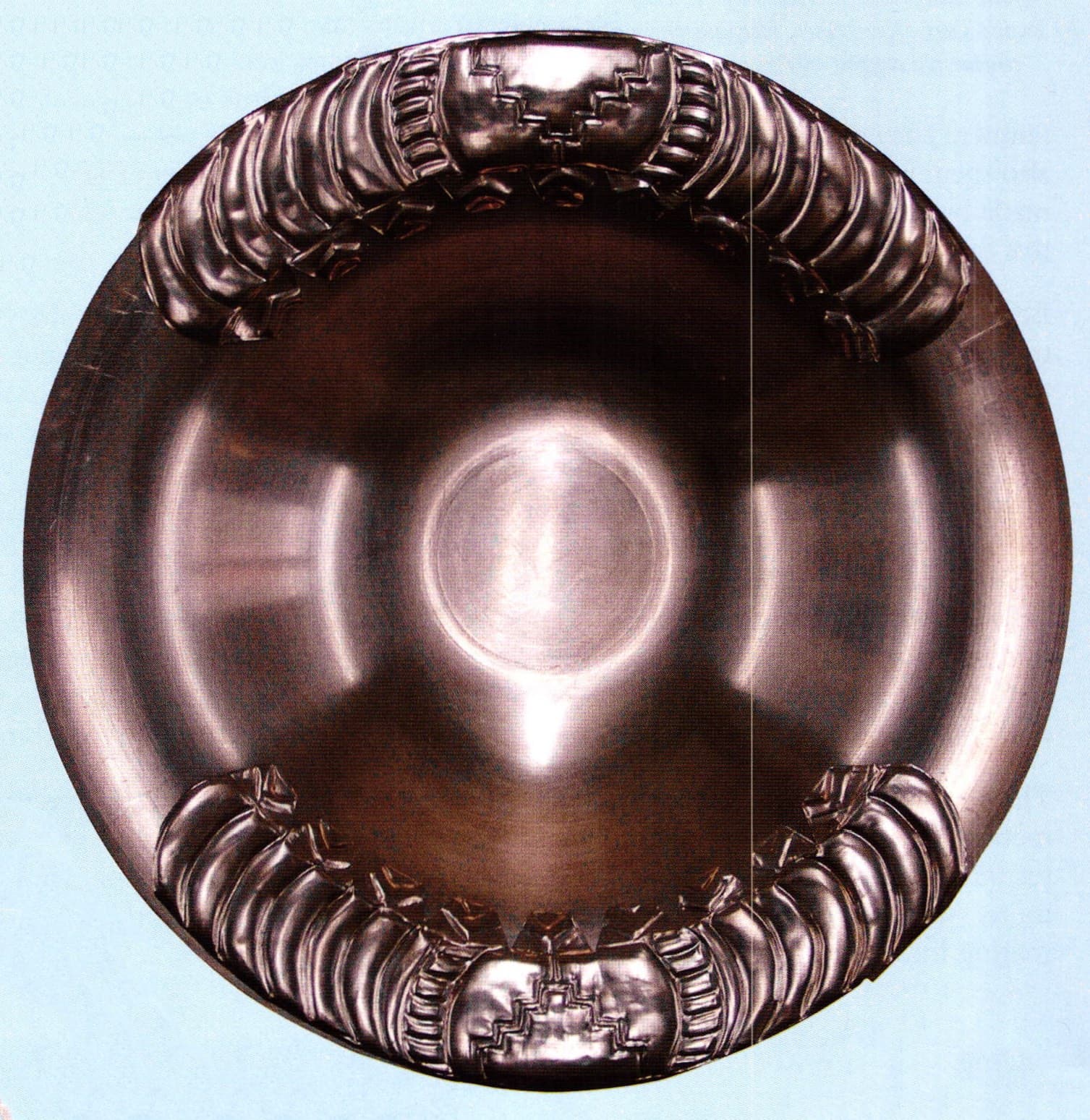
Working on the front of the piece only is called chasing. Repousse is the combination of tracing the design on the front of the piece using liners (tracers), raising a relief by pushing from the back using different punches, and finally working the details on the front of the piece. This method is the classical repousse technique. There is also a "direct" repousse in which the design is drawn or transferred on the back of the piece, and the relief is raised directly from there, thus eliminating the initial tracing of the design.... (2003)
Complete Story

Show me more articles from: [Chasing and Repoussé - a Mystery Revealed]|[Valentin Yotkov]
Releated Categories: [Chasing and repousse]


Page: 2